Belt Pulleys

Belt Pulleys

Belt Pulleys play a critical role in power transmission systems by enabling smooth and efficient transfer of mechanical energy between rotating shafts. Designed to work seamlessly with various types of belts, including V-belts, timing belts, and flat belts, these pulleys ensure optimal alignment and consistent performance in both light-duty and heavy-duty applications. Their precise groove geometry and balanced construction help reduce vibration, minimize wear, and extend the lifespan of both the pulley and the belt. As a result, Belt Pulleys are widely used across industries such as manufacturing, mining, agriculture, and HVAC systems.

The performance of a Belt Pulley is heavily influenced by its material quality and design accuracy. High-grade cast iron, steel, or aluminum alloys are commonly used to provide strength, corrosion resistance, and thermal stability. Advanced manufacturing techniques ensure tight tolerances and excellent surface finish, which contribute to efficient power transmission and reduced energy loss. Additionally, Belt Pulleys are available in various sizes and configurations, allowing for customization based on speed ratios, load requirements, and environmental conditions. Their adaptability makes them an indispensable component in modern machinery, where reliability and efficiency are paramount. By optimizing belt engagement and maintaining consistent tension, Belt Pulleys help improve overall system productivity while reducing maintenance costs.

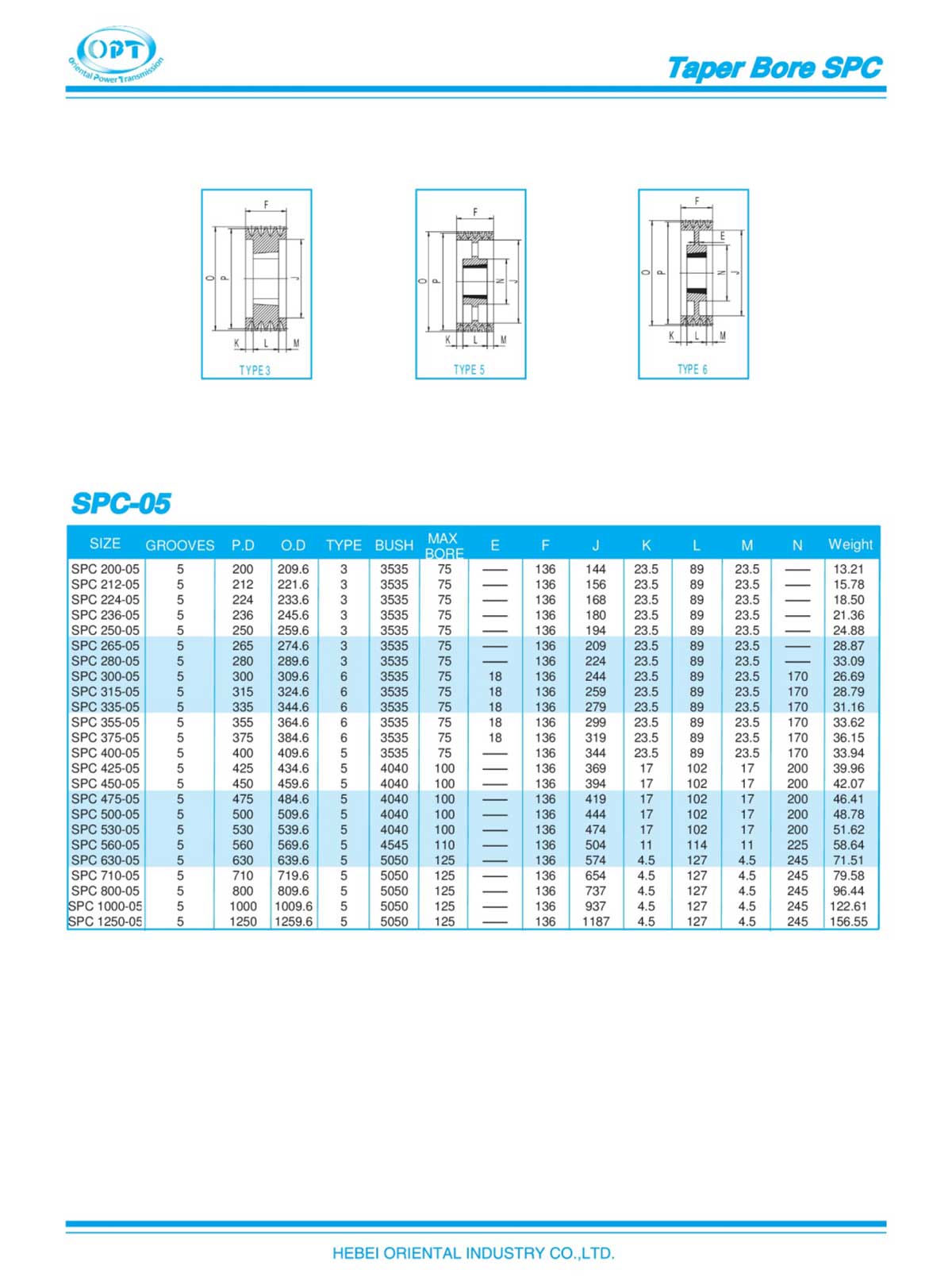
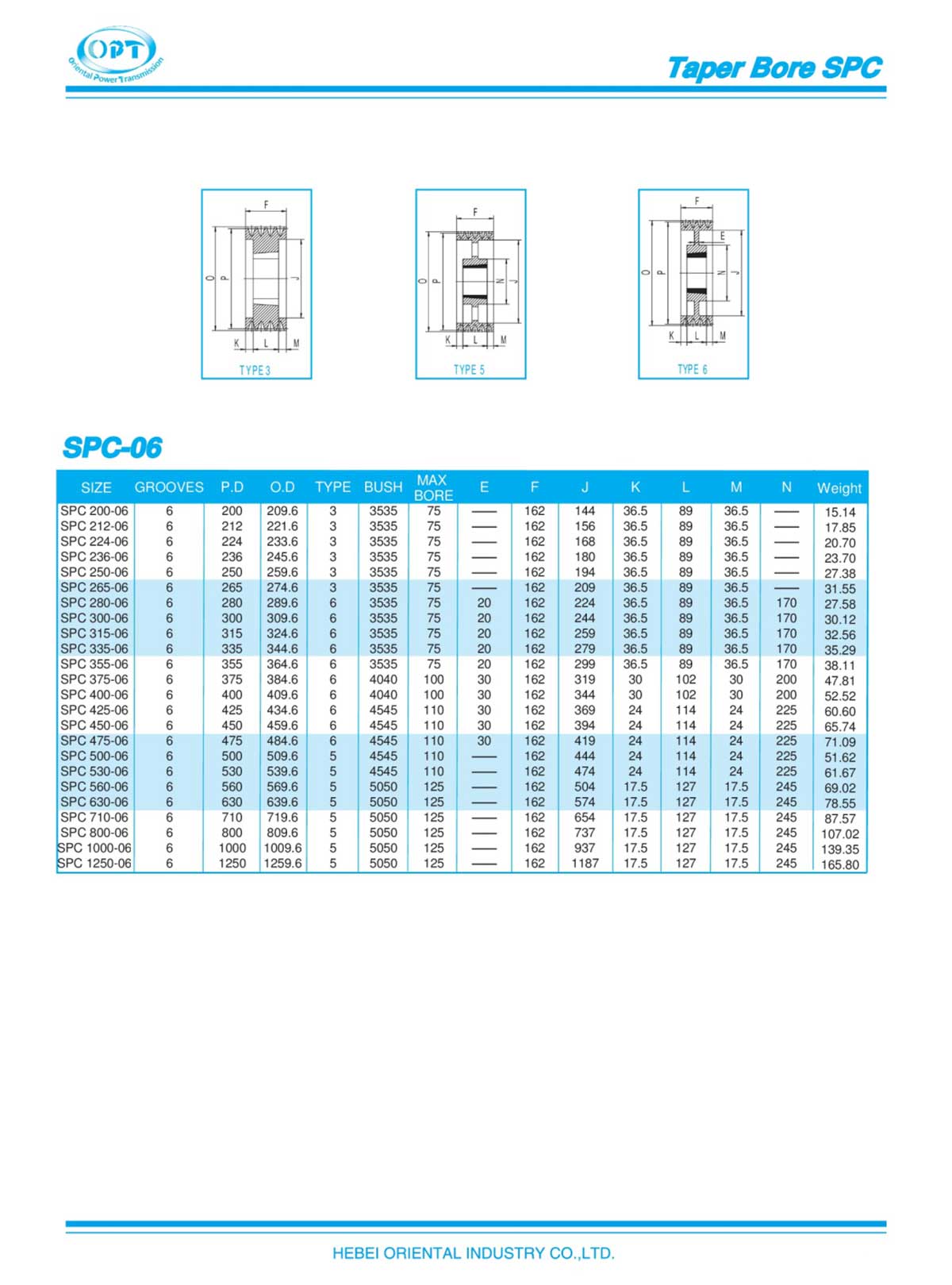
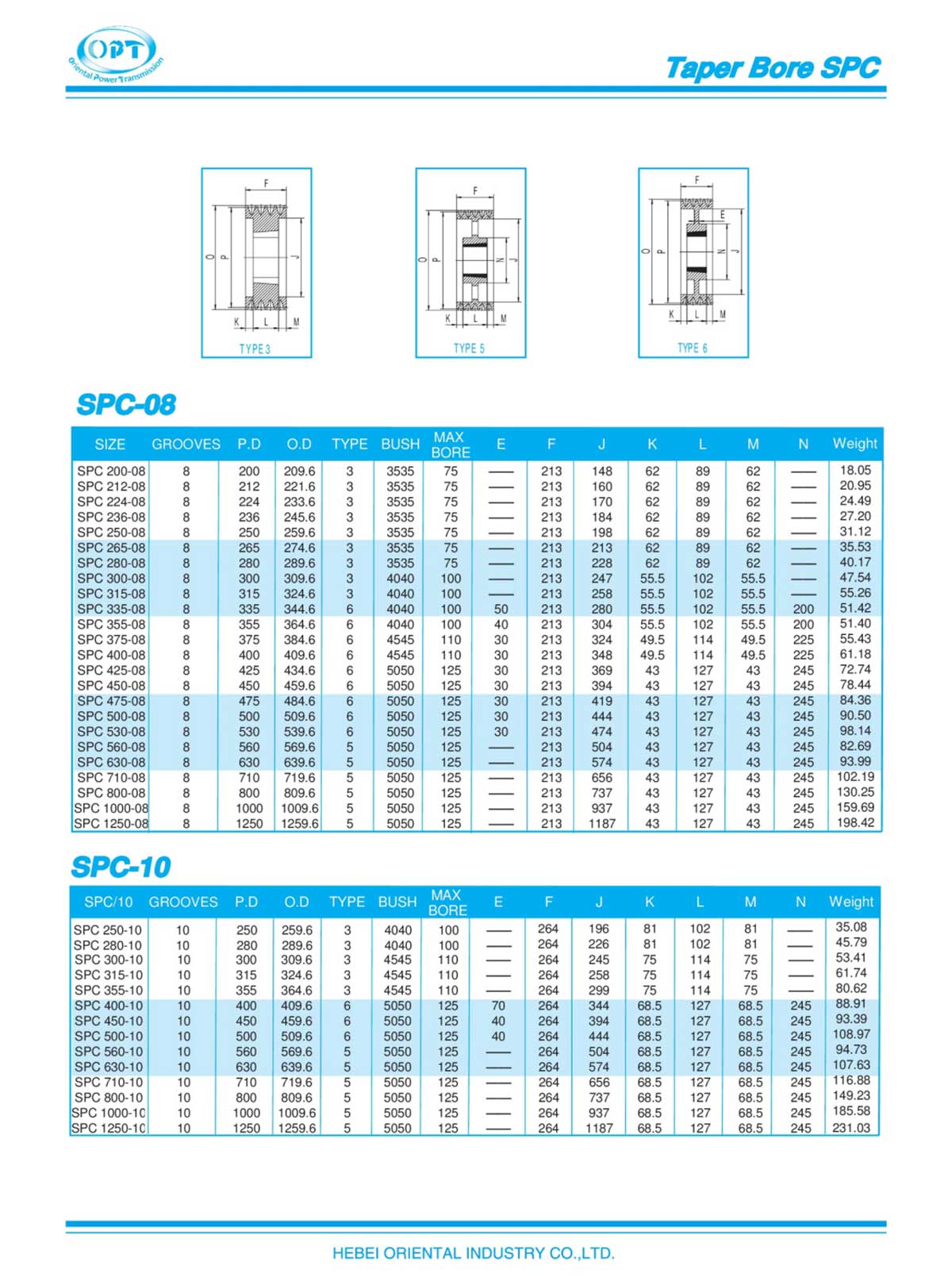
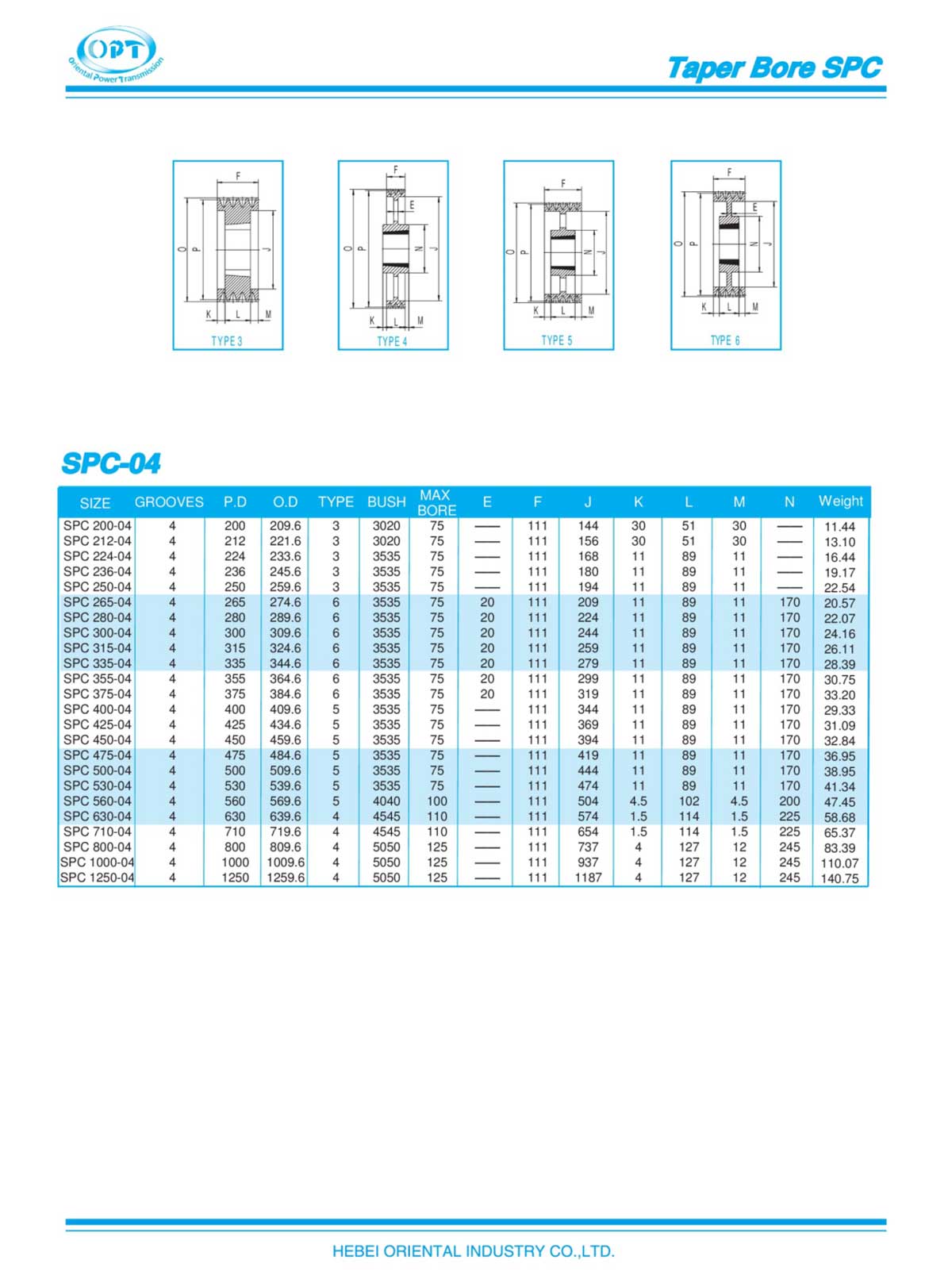
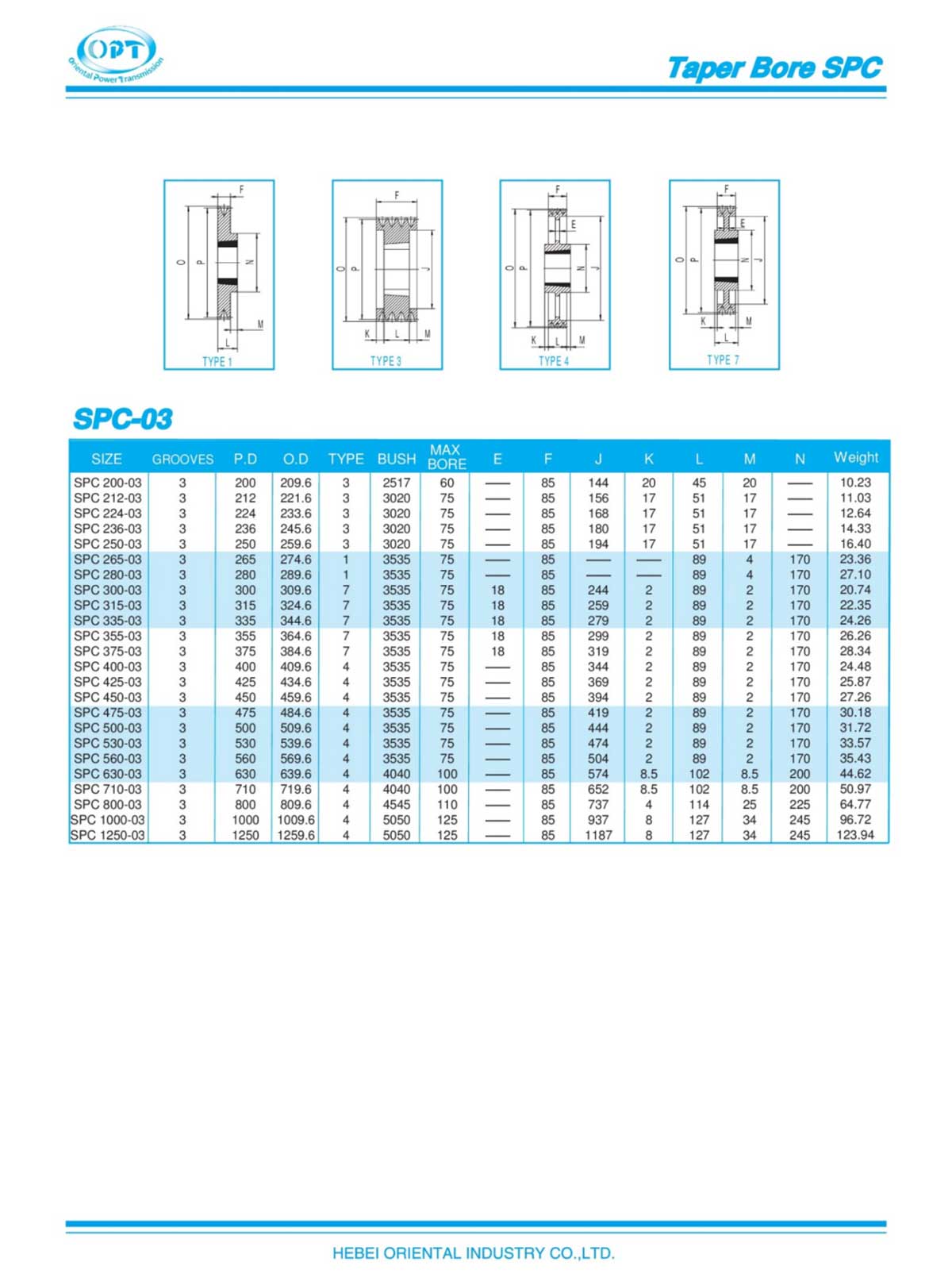
  • Taper Bore V-Pulleys SPC
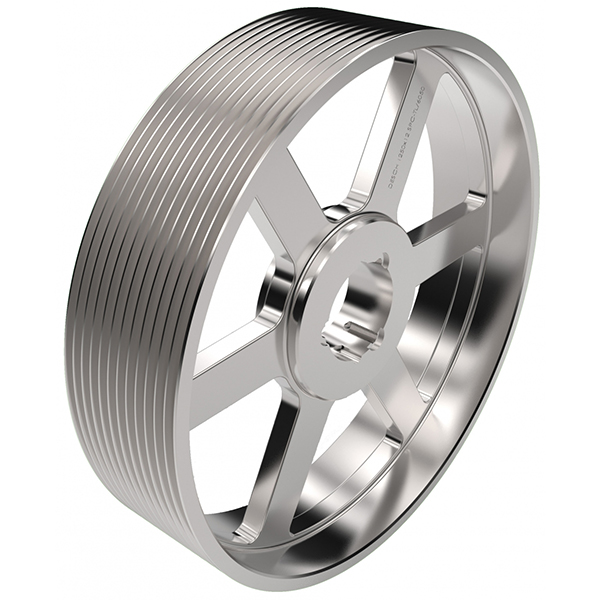
    SPC taper bore V-pulleys are built for heavy-duty applications requiring high strength and maximum power transmission. Their robust design ensures stability and long service life under demanding conditions. Ideal for industrial machinery, they deliver reliable performance and improved operational efficiency.

    SPC-3  SPC-4  SPC-5  SPC-6  SPC-8  SPC-10

    Narrow V belt SPZ SPA SPB SPC, each type of triangle belt defines the section size of triangle belt.   At the same time, the minimum diameter of the small belt pulley corresponding to each wheel groove Angle of each type of triangle belt is specified, but the large belt pulley is not specified.  The belt pulley groove Angle is divided into 34 degrees 38 degrees, the specific selection should be based on the belt pulley groove type and benchmark diameter selection;  The slot Angle of the belt pulley is related to the diameter of the belt pulley. The recommended slot angles of different types of belt pulley in different diameters are as follows: SPC V-belt pulley When the pulley diameter <=315mm, the Angle is 34 degrees.  SPC V-belt pulley When the pulley diameter >315mm, the Angle is 38 degrees.

    ds (1)

    ds (2)

    ds (3)

    ds (4)

    ds (5)


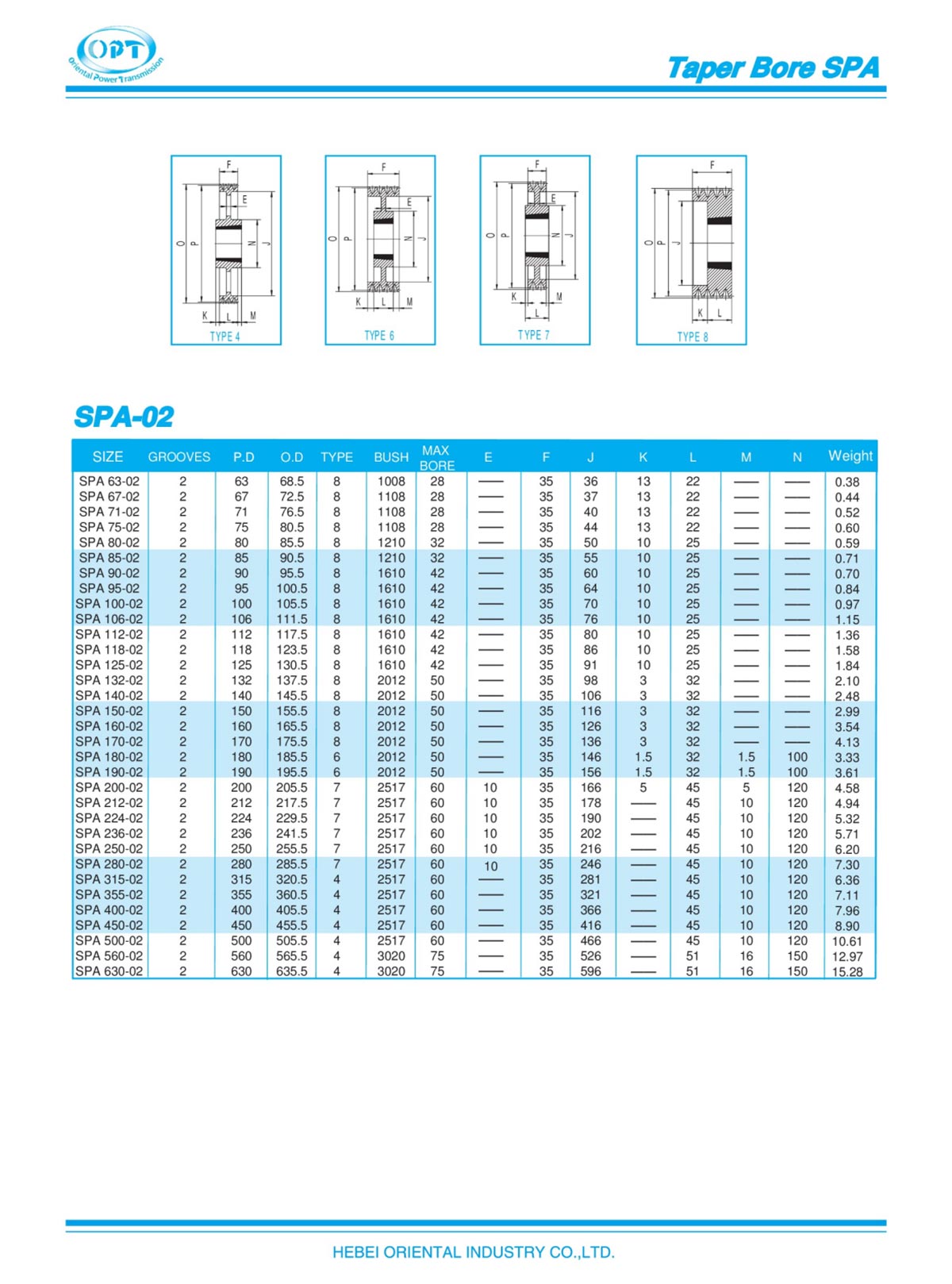
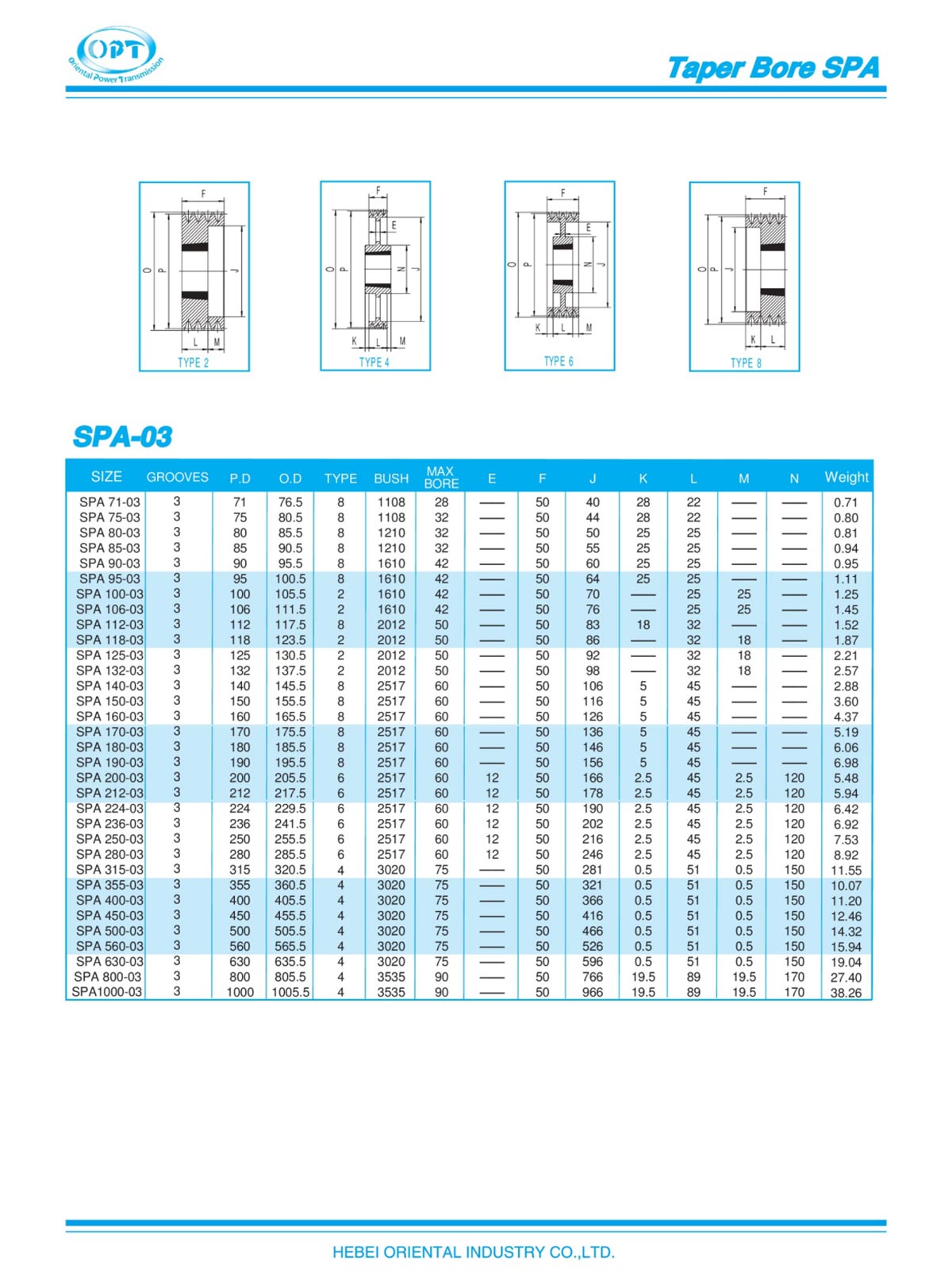
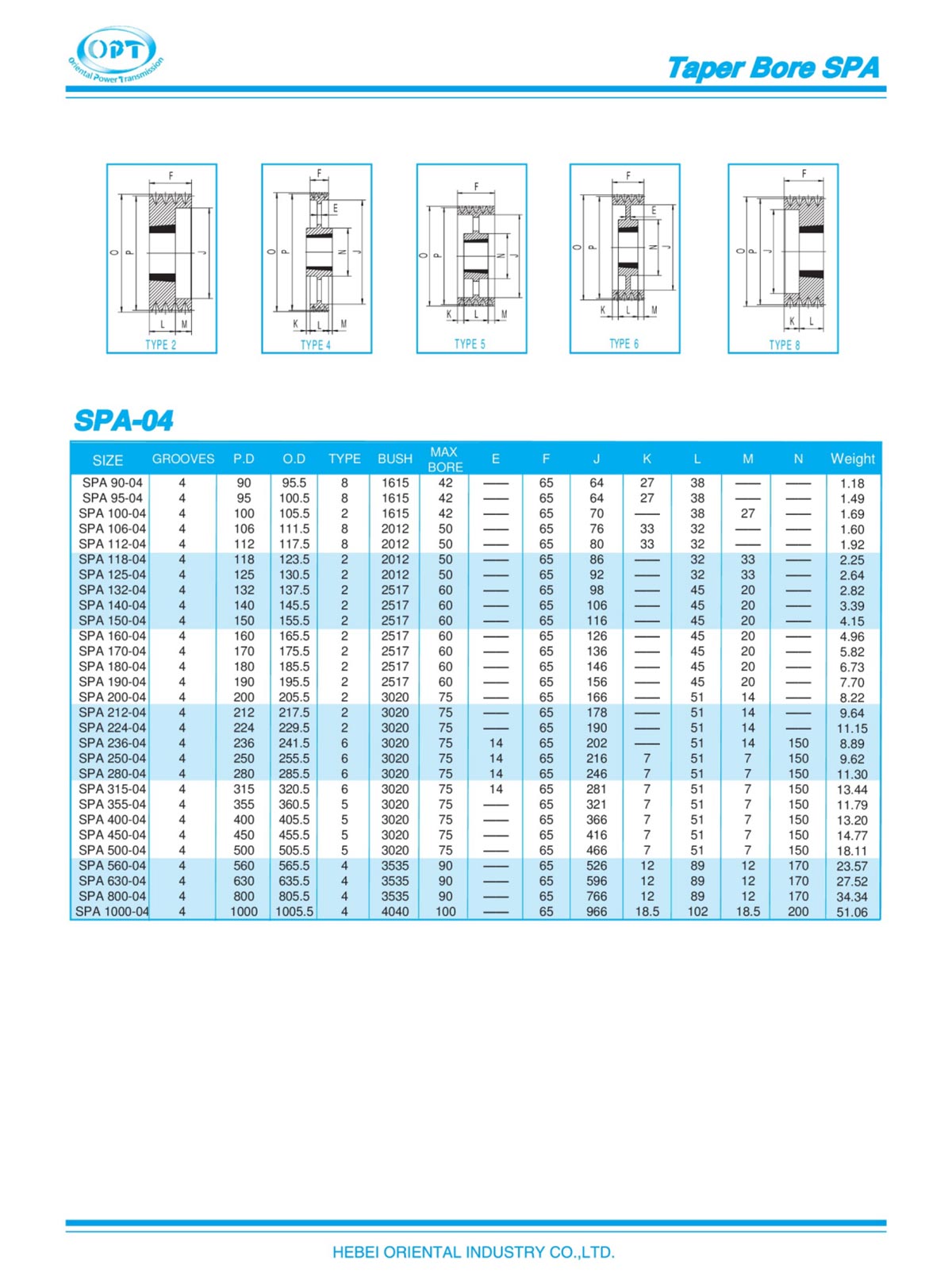
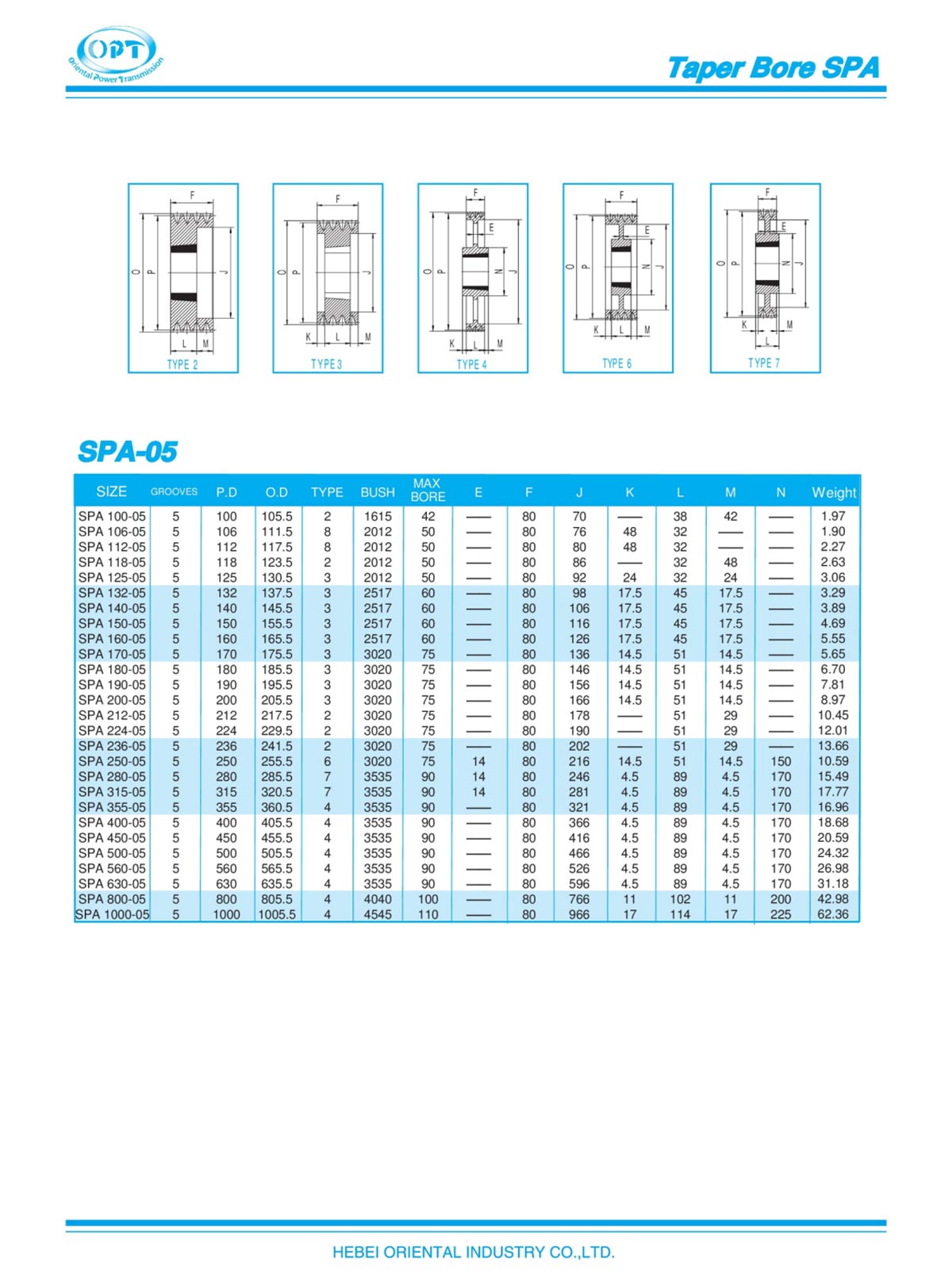
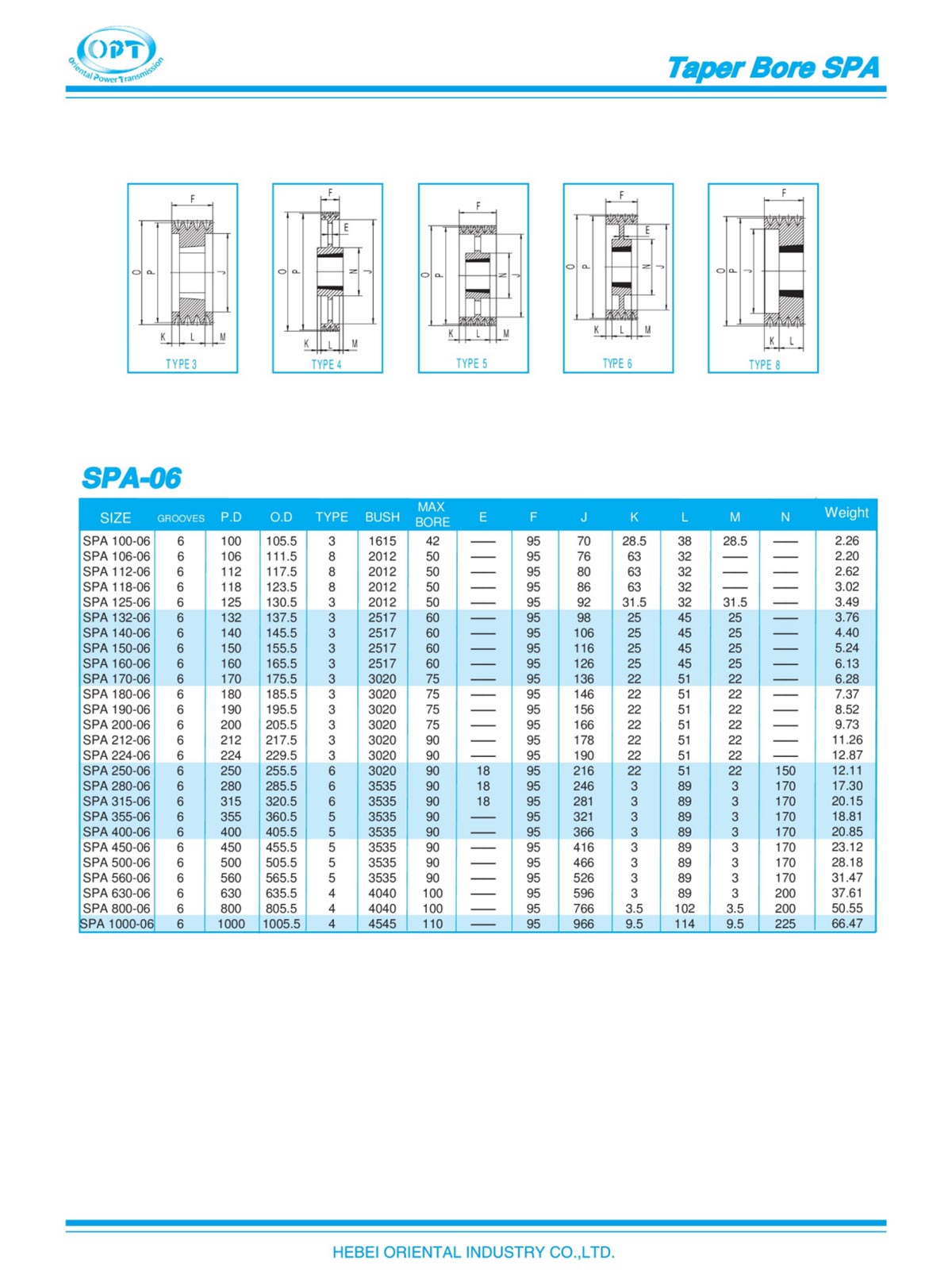
  • Taper Bore V-Pulleys SPA
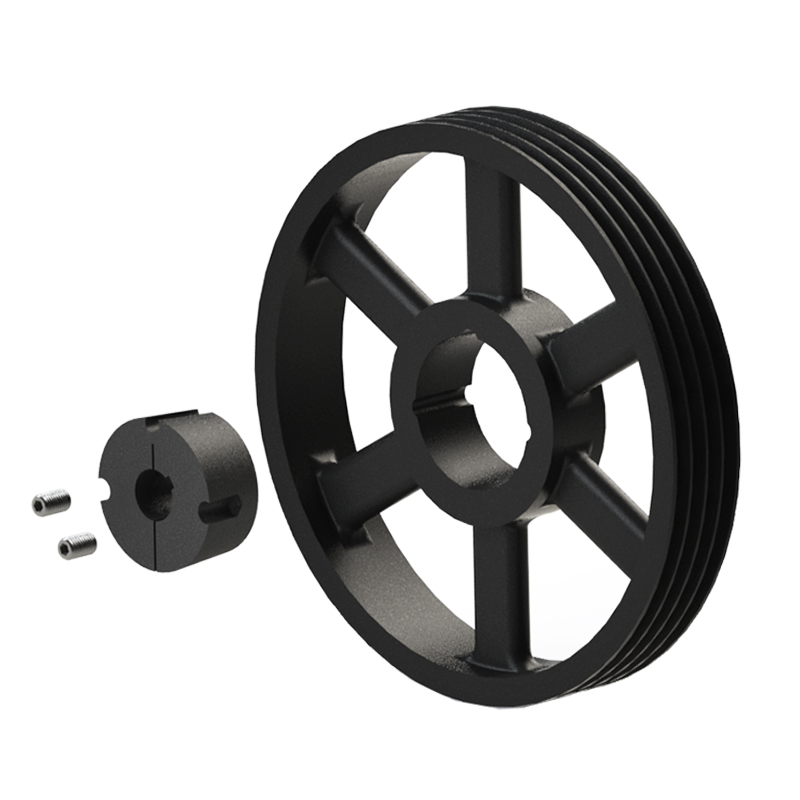
    SPA taper bore V-pulleys are designed for higher performance and durability in demanding applications. They provide strong grip and efficient power transfer while ensuring easy installation. Widely used in industrial machinery, these pulleys help improve operational efficiency and reduce maintenance requirements.

    Narrow V belt SPZ SPA SPB SPC, each type of triangle belt defines the section size of triangle belt.   At the same time, the minimum diameter of the small belt pulley corresponding to each wheel groove Angle of each type of triangle belt is specified, but the large belt pulley is not specified.  The belt pulley groove Angle is divided into 34 degrees 38 degrees, the specific selection should be based on the belt pulley groove type and benchmark diameter selection;  The slot Angle of the belt pulley is related to the diameter of the belt pulley. The recommended slot angles of different types of belt pulley in different diameters are as follows: SPA V-belt pulley When the pulley diameter <=118mm, the Angle is 34 degrees.  SPA V-belt pulley When the pulley diameter >118mm, the Angle is 38 degrees.

    t (2)

    t (3)

    t (4)

    t (5)

    t (6)


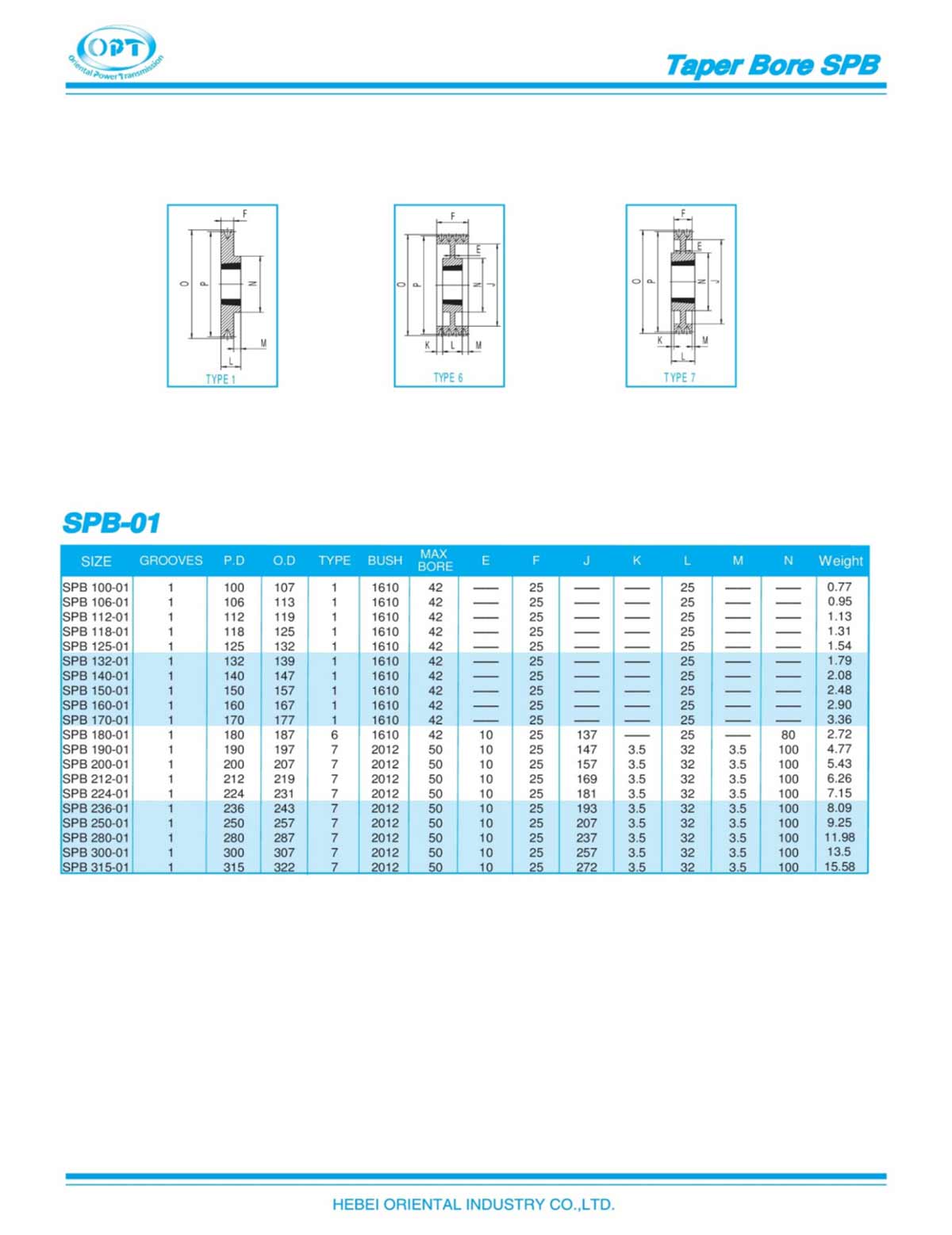
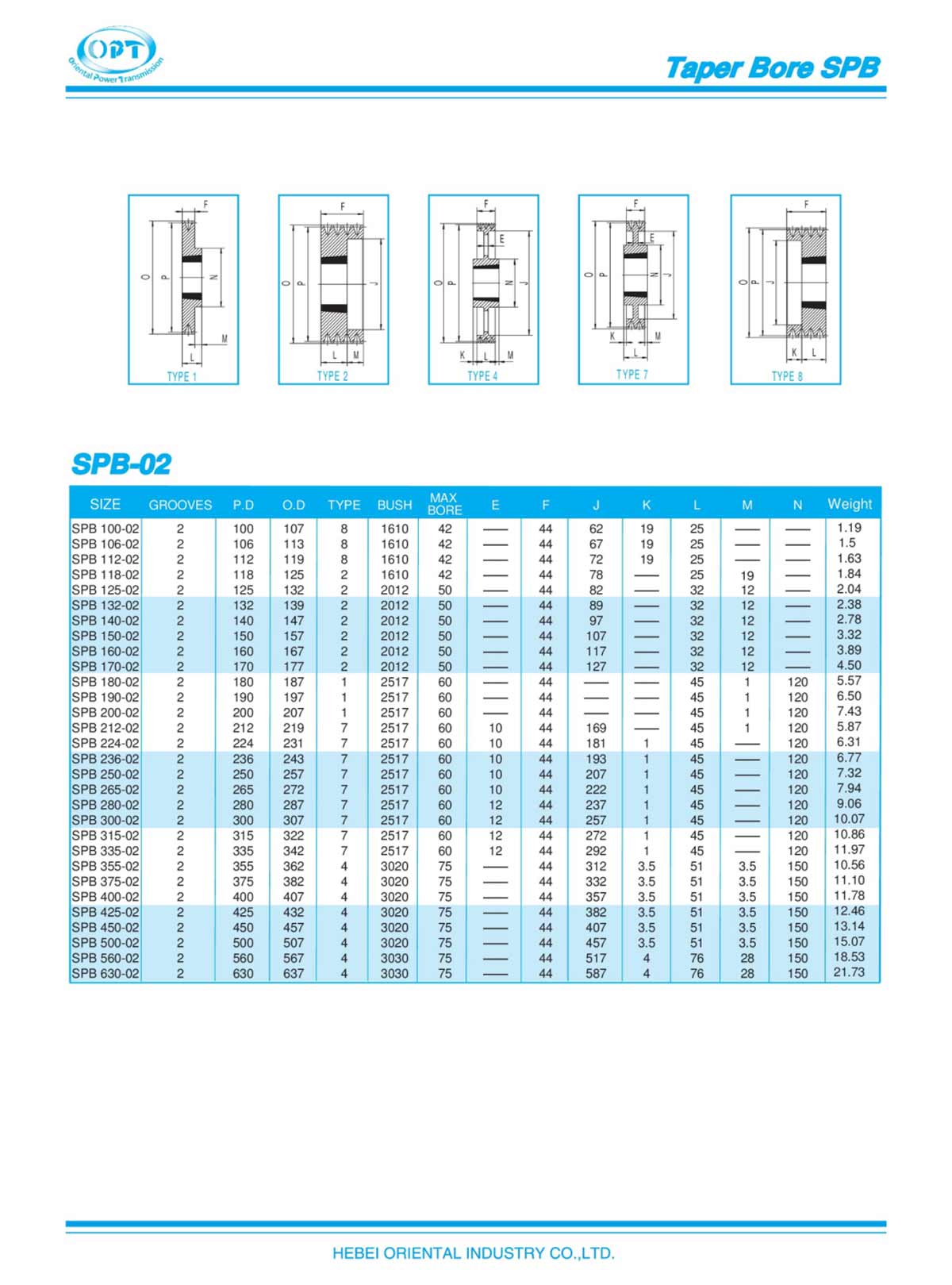
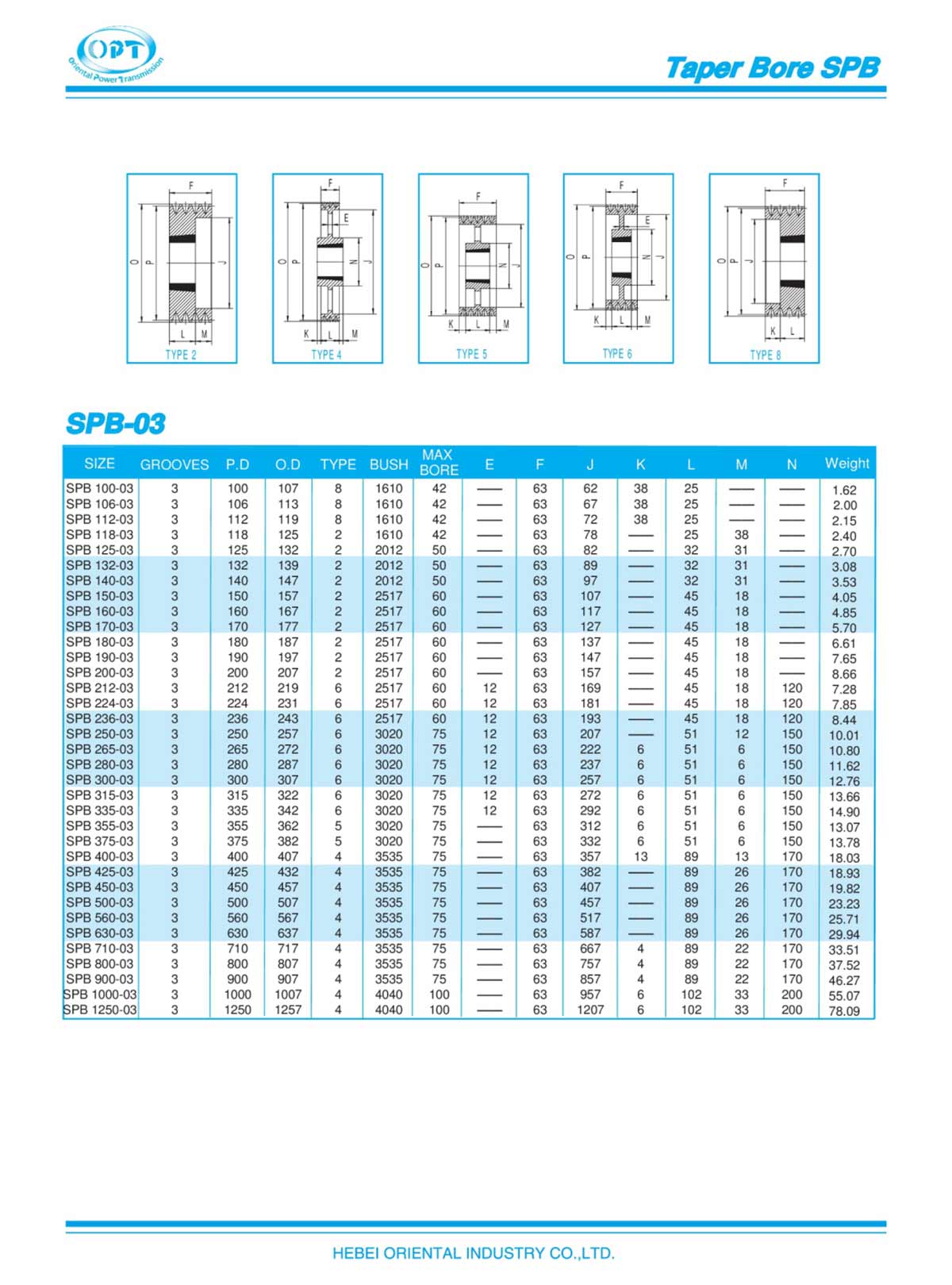
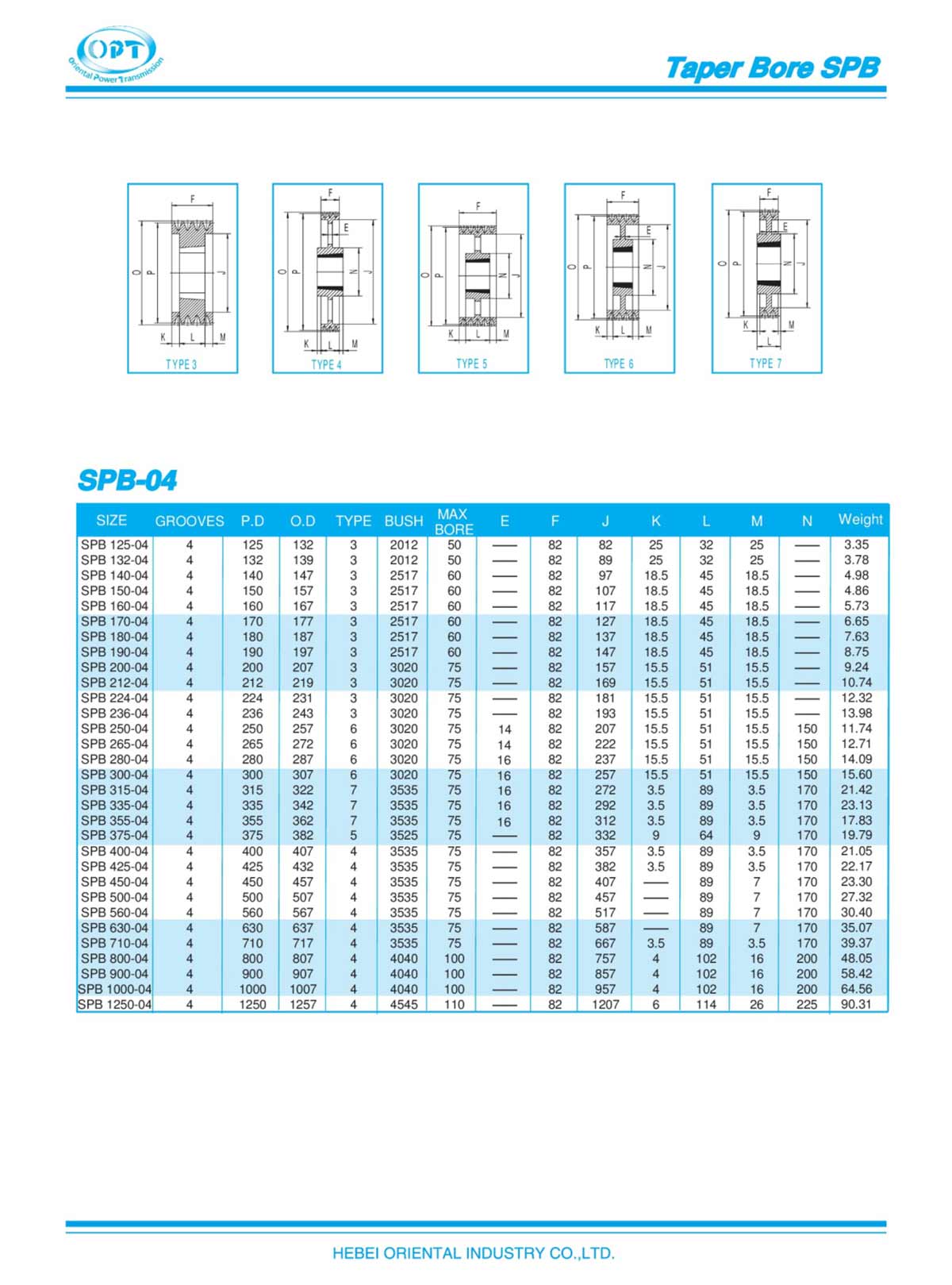
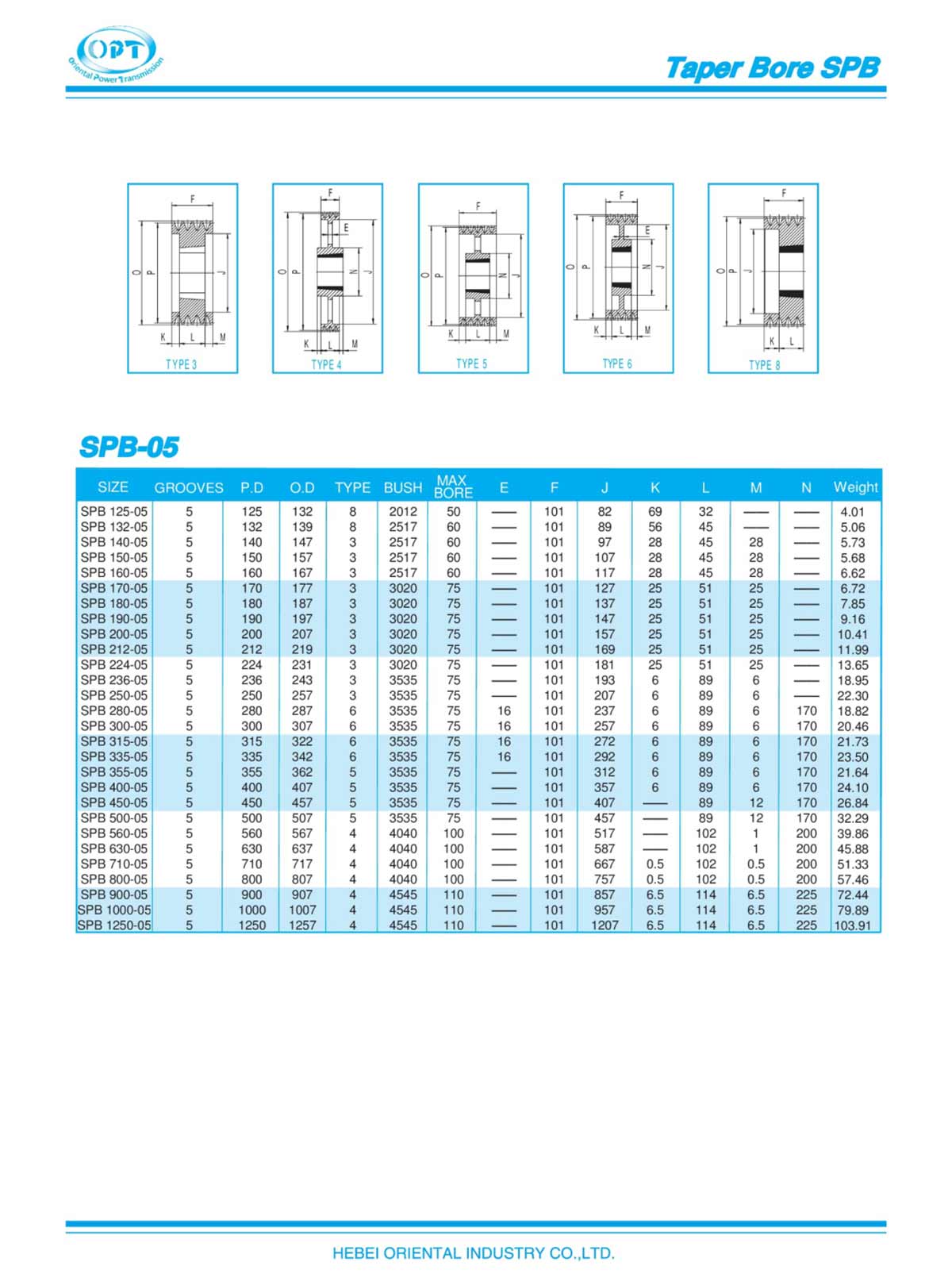
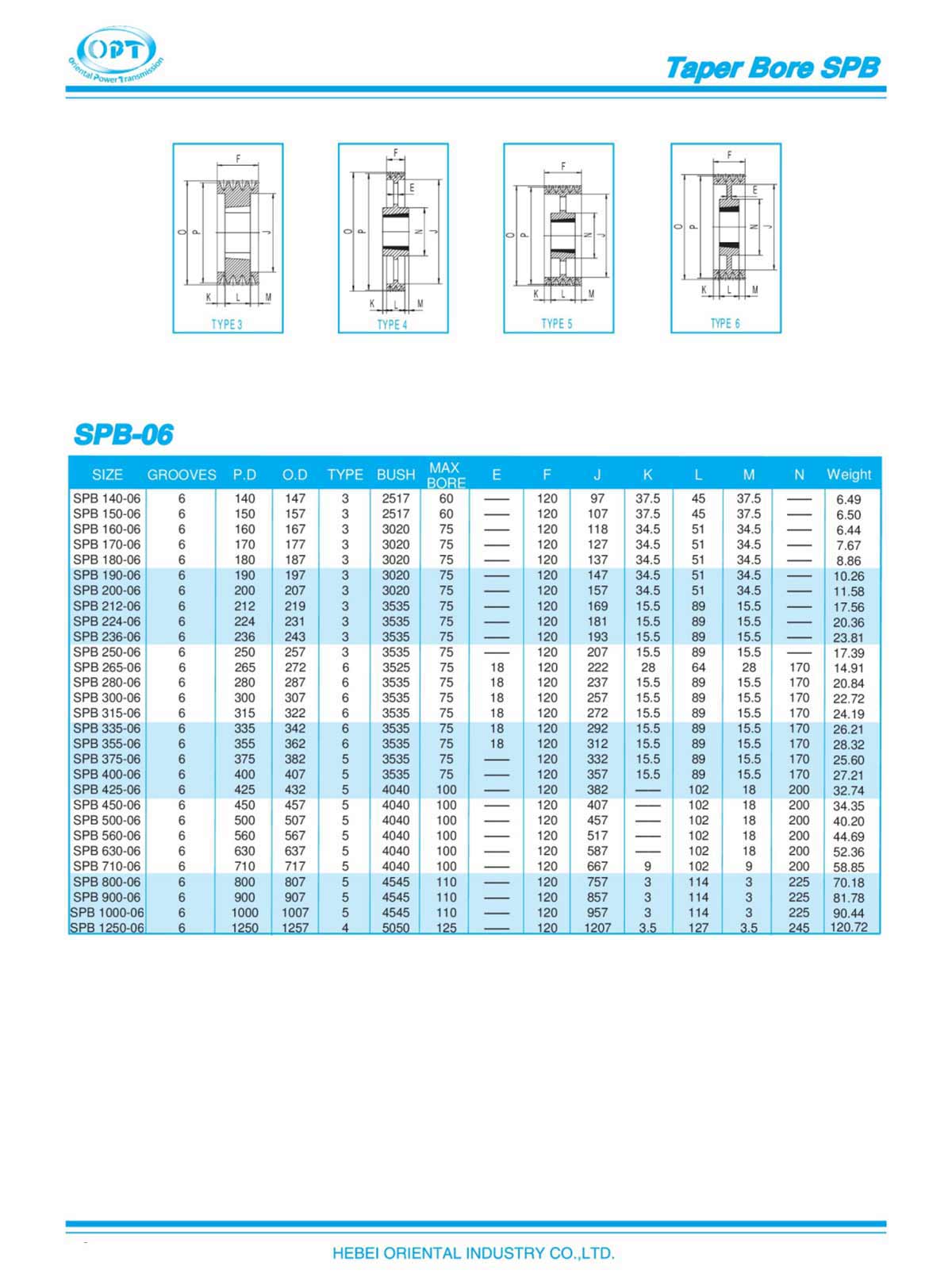
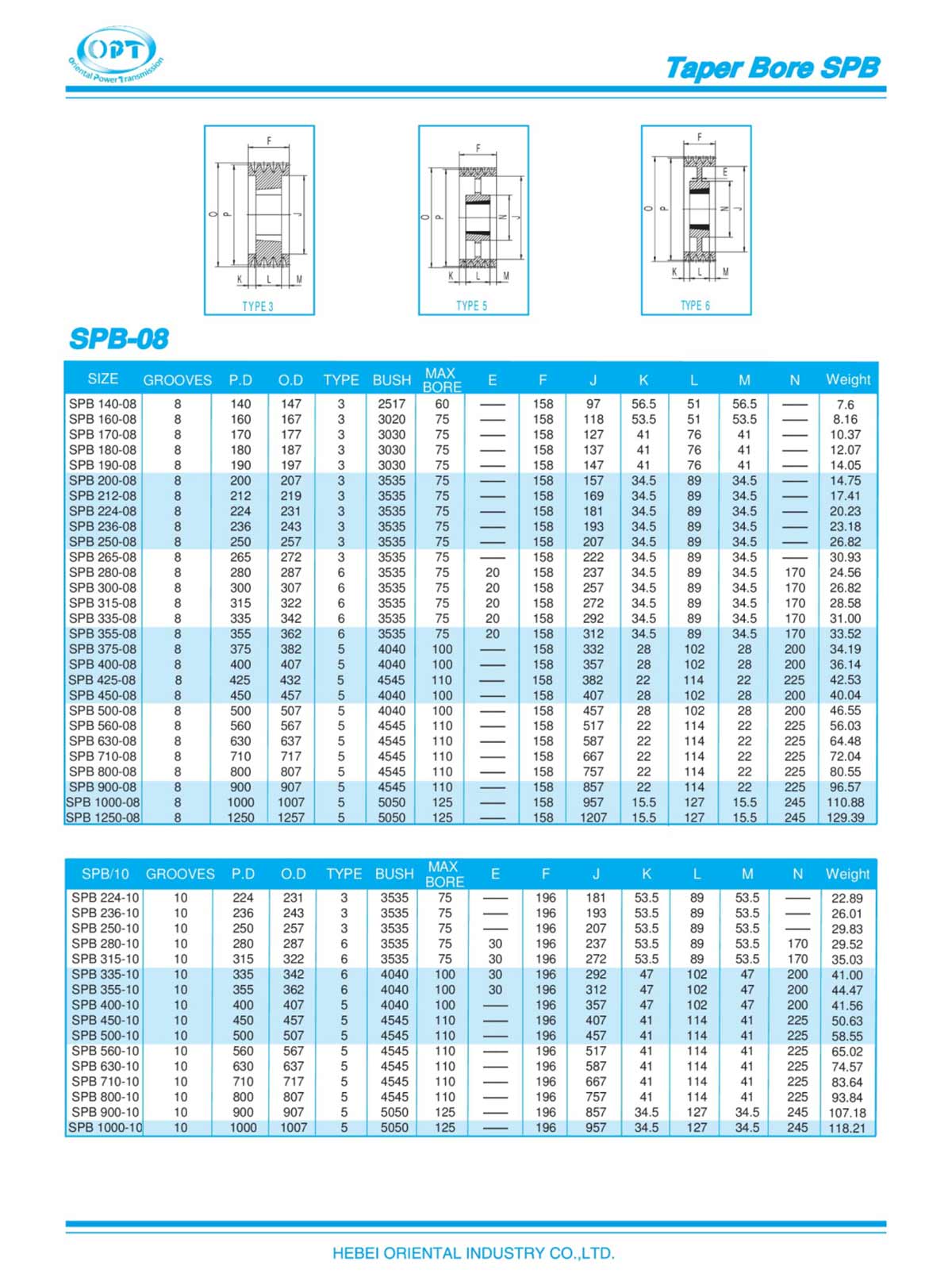
  • Taper Bore V-Pulleys SPB
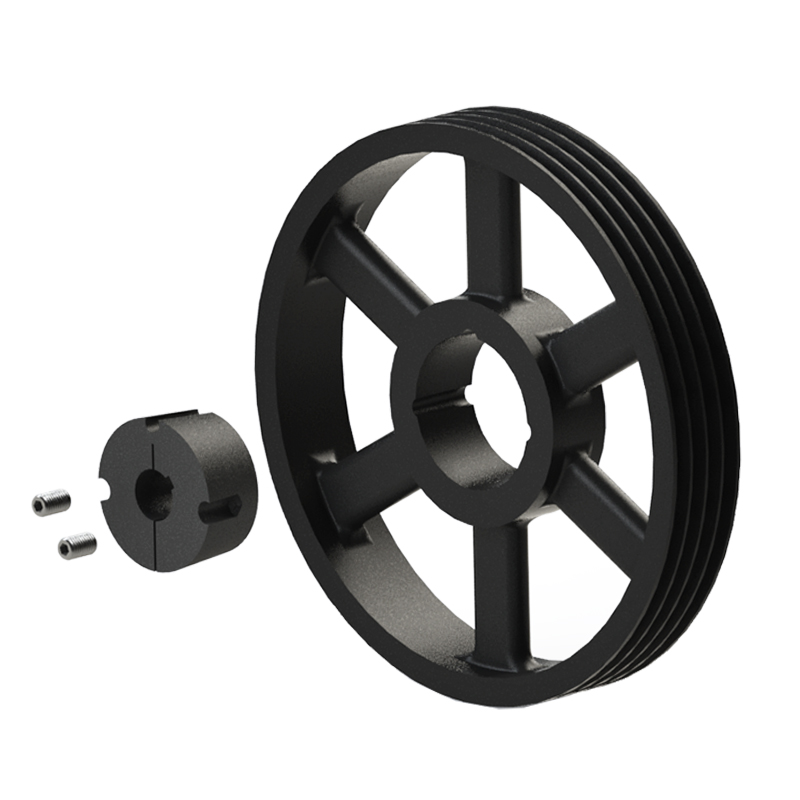
    SPB taper bore V-pulleys offer improved load capacity and reliable performance in medium-duty applications. Their taper bore design allows easy installation and precise alignment. Suitable for various industrial systems, they provide efficient power transmission, reduced vibration, and extended service life.

    SPB-1  SPB-2  SPB-3  SPB-4  SPB-5  SPB-6   SPB-8  SPB-10

    Narrow V belt SPZ SPA SPB SPC, each type of triangle belt defines the section size of triangle belt.   At the same time, the minimum diameter of the small belt pulley corresponding to each wheel groove Angle of each type of triangle belt is specified, but the large belt pulley is not specified.  The belt pulley groove Angle is divided into 34 degrees 38 degrees, the specific selection should be based on the belt pulley groove type and benchmark diameter selection;  The slot Angle of the belt pulley is related to the diameter of the belt pulley. The recommended slot angles of different types of belt pulley in different diameters are as follows: SPB V-belt pulley When the pulley diameter <=190mm, the Angle is 34 degrees.  SPB V-belt pulley When the pulley diameter >190mm, the Angle is 38 degrees.

    f (1)

    f (2)

    f (3)

    f (4)

    f (5)

    f (6)

    f (7)


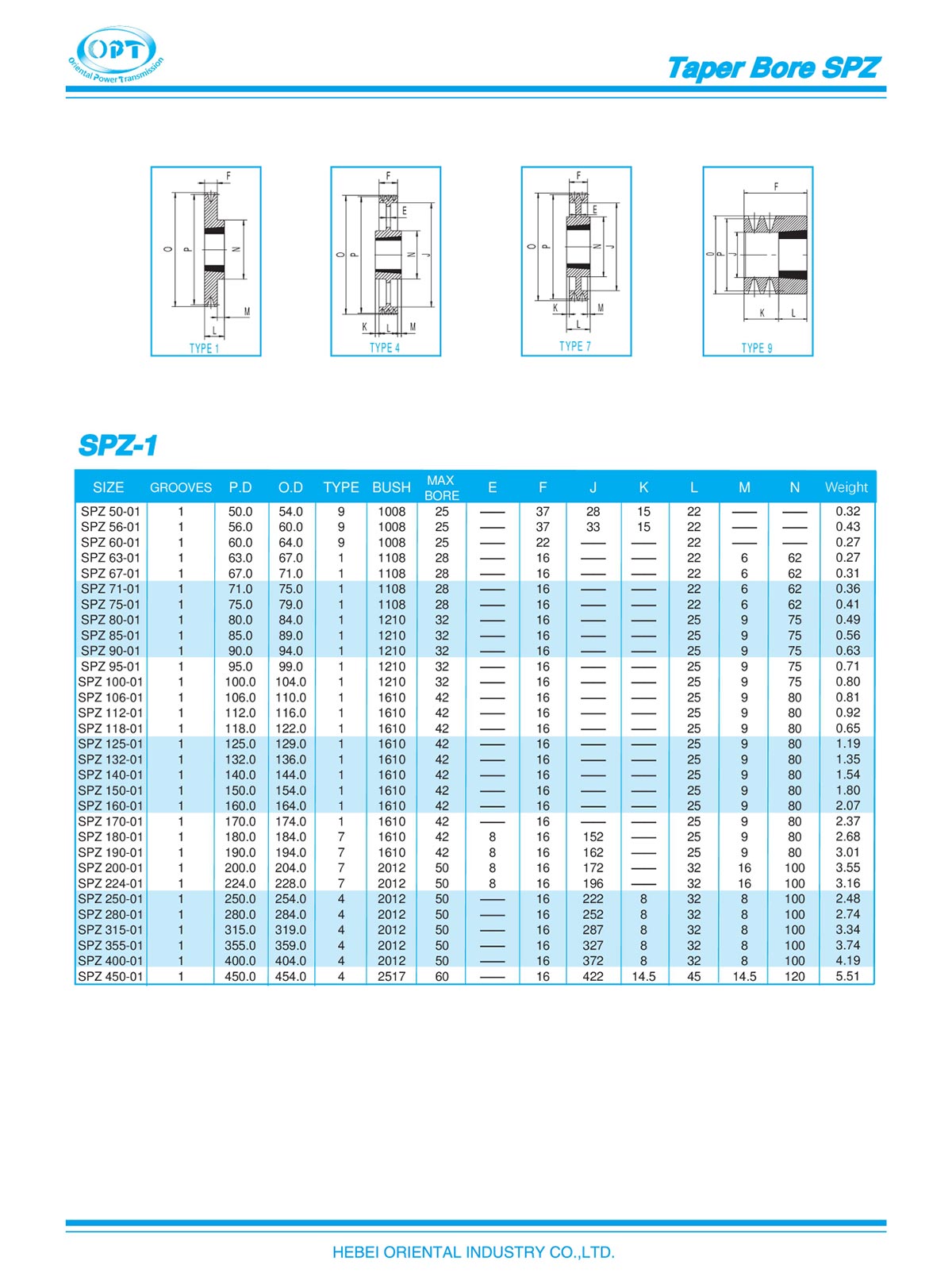
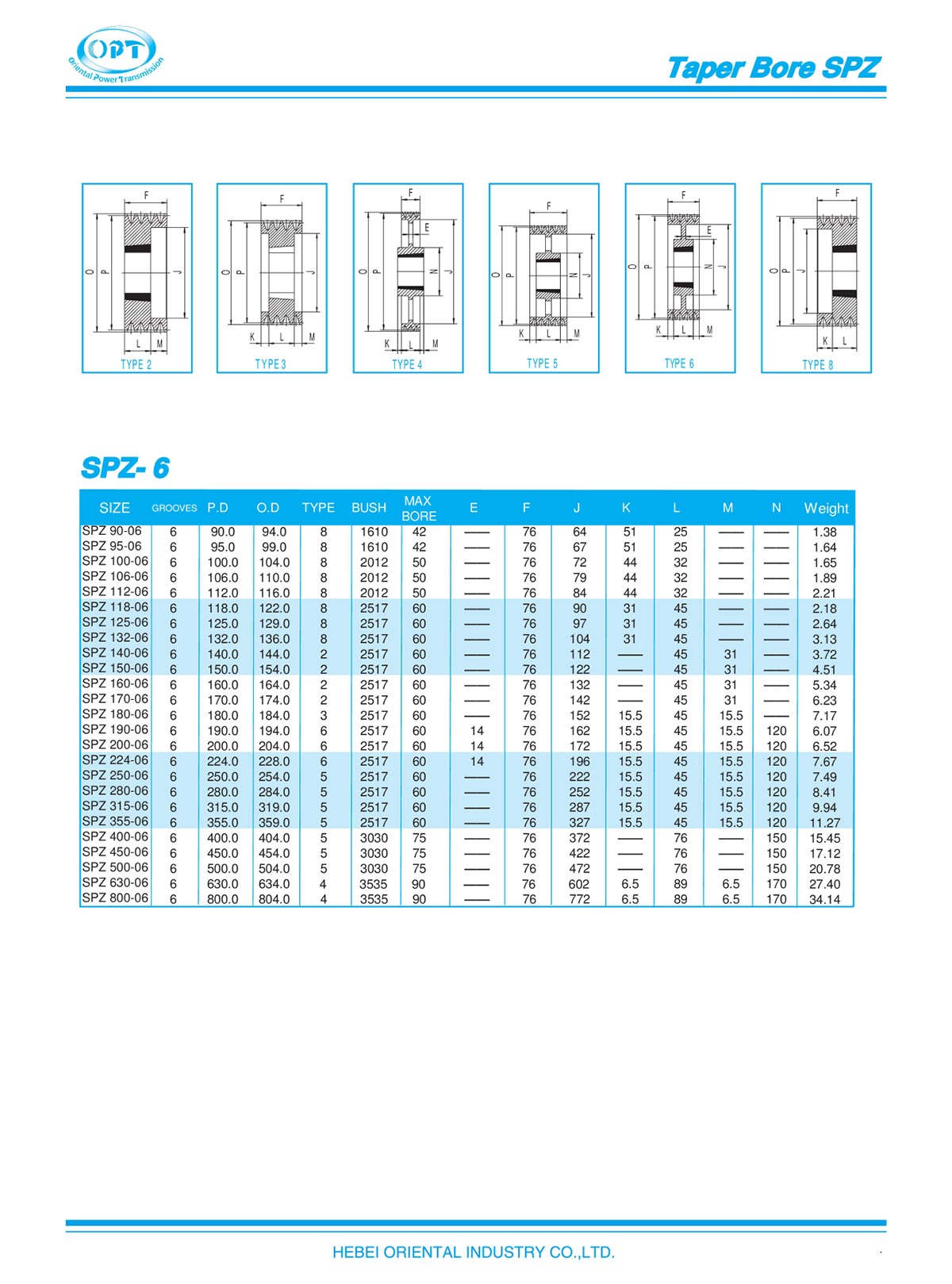
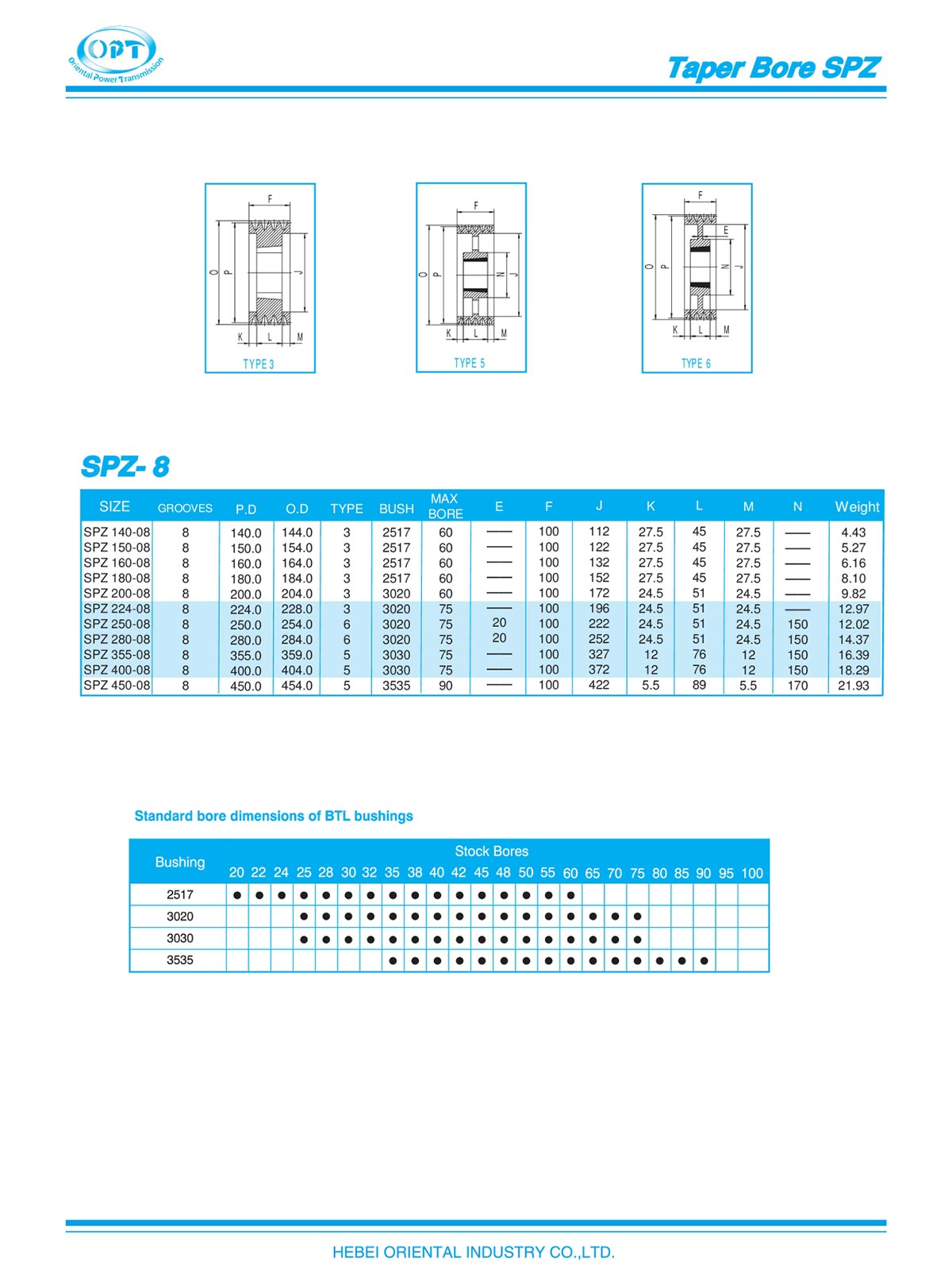
  • Taper Bore V-Pulleys SPZ
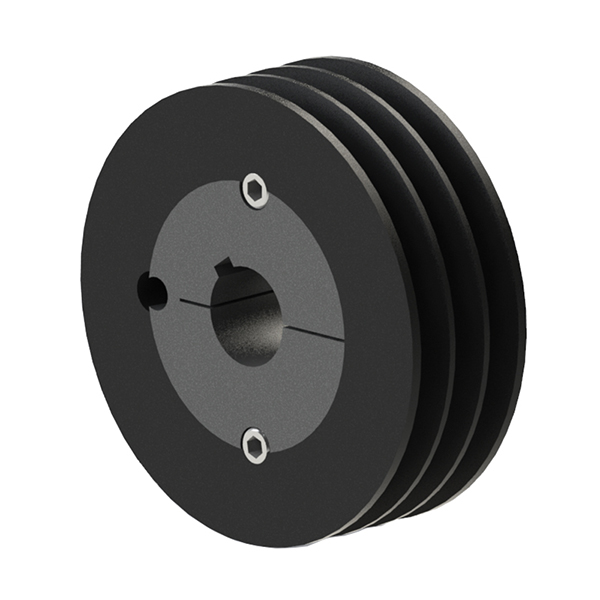
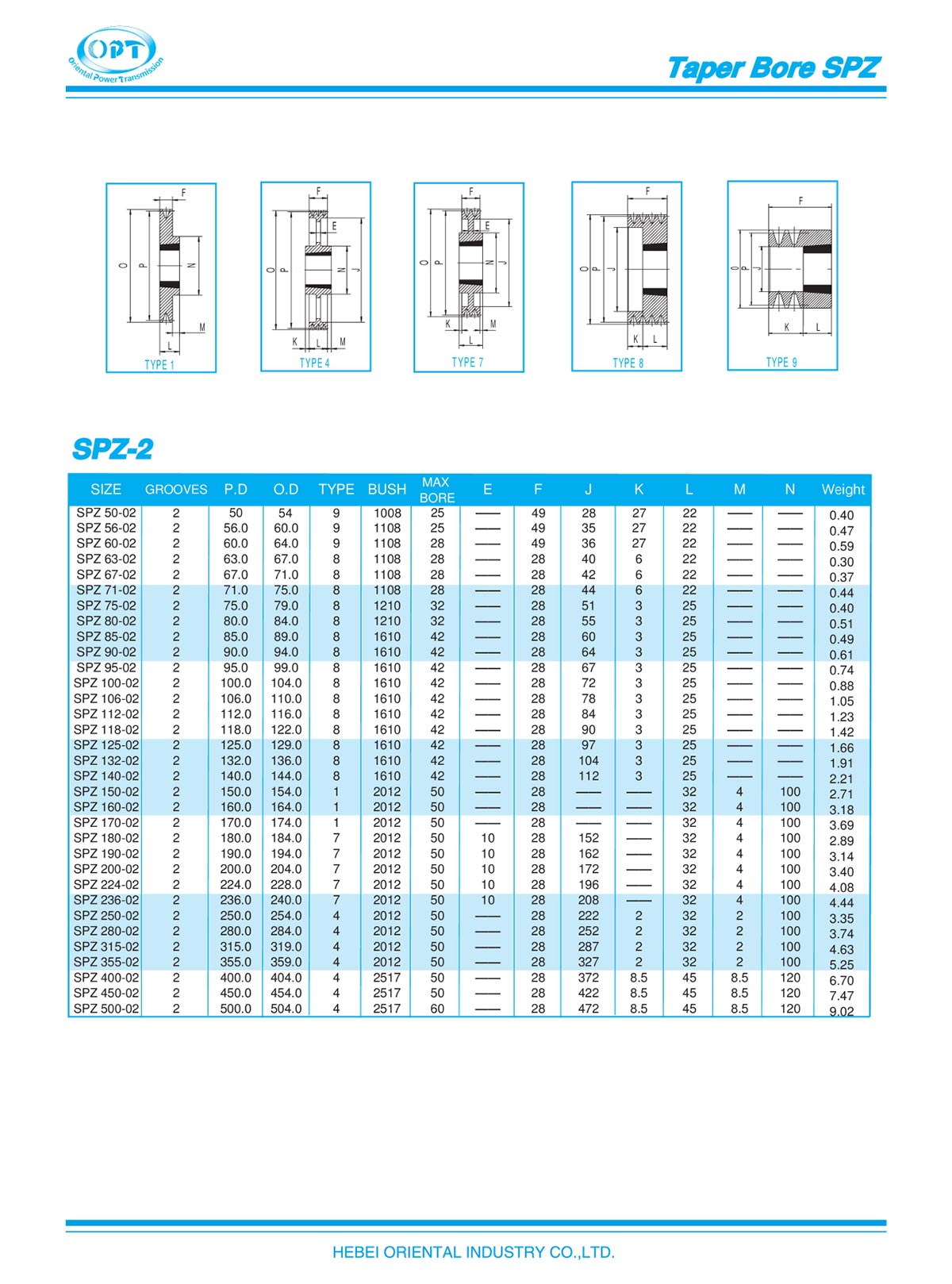
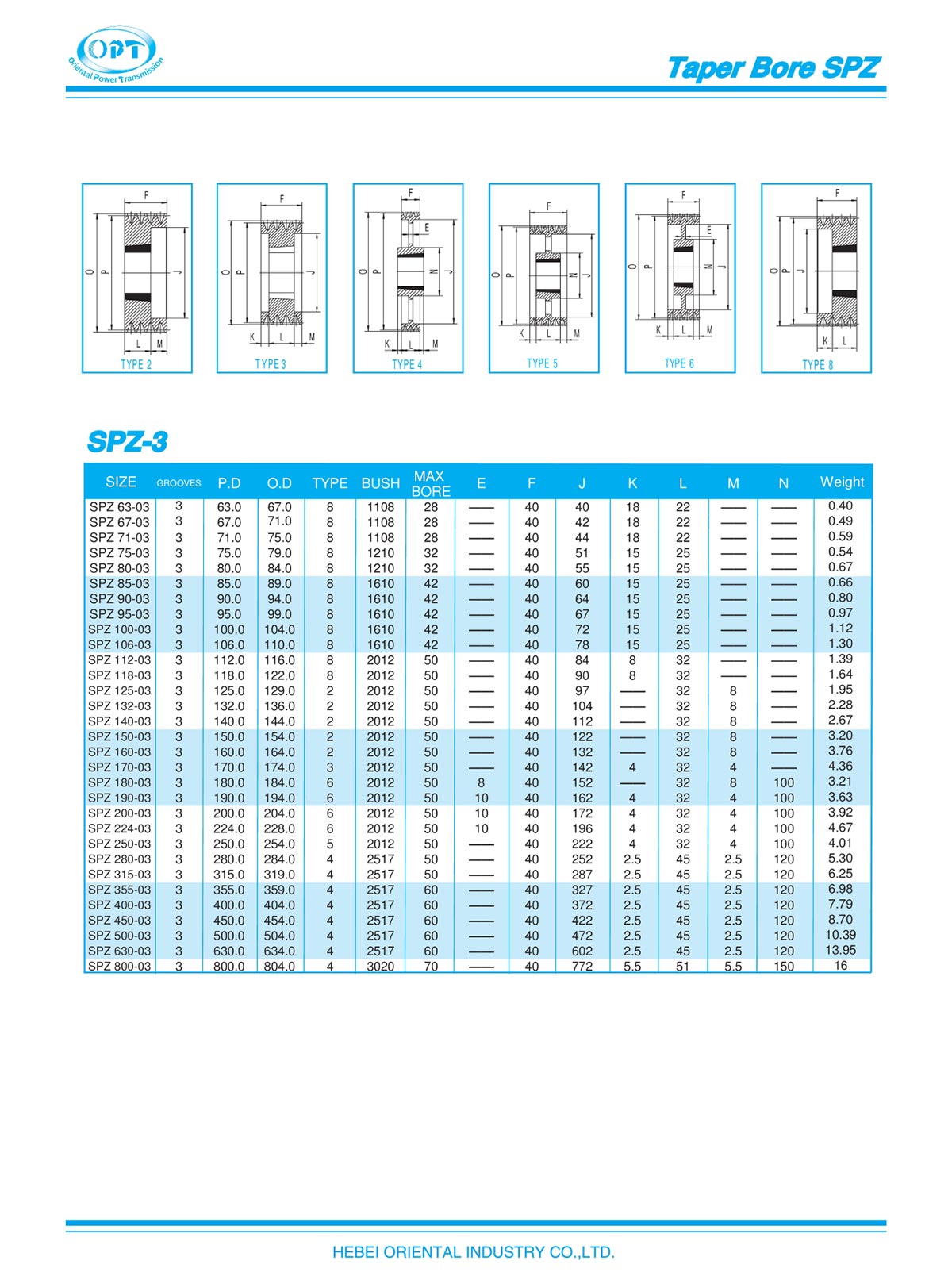
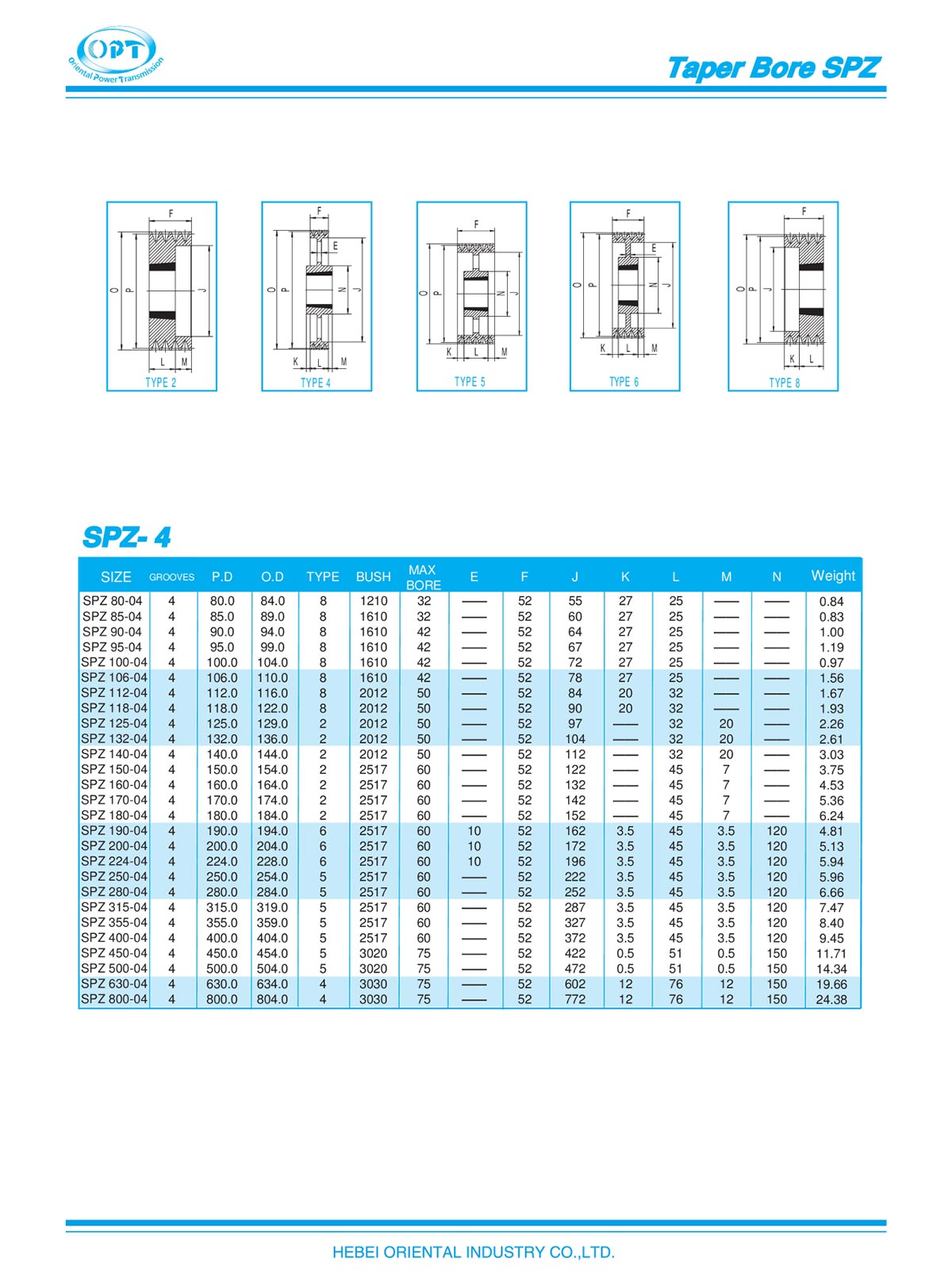
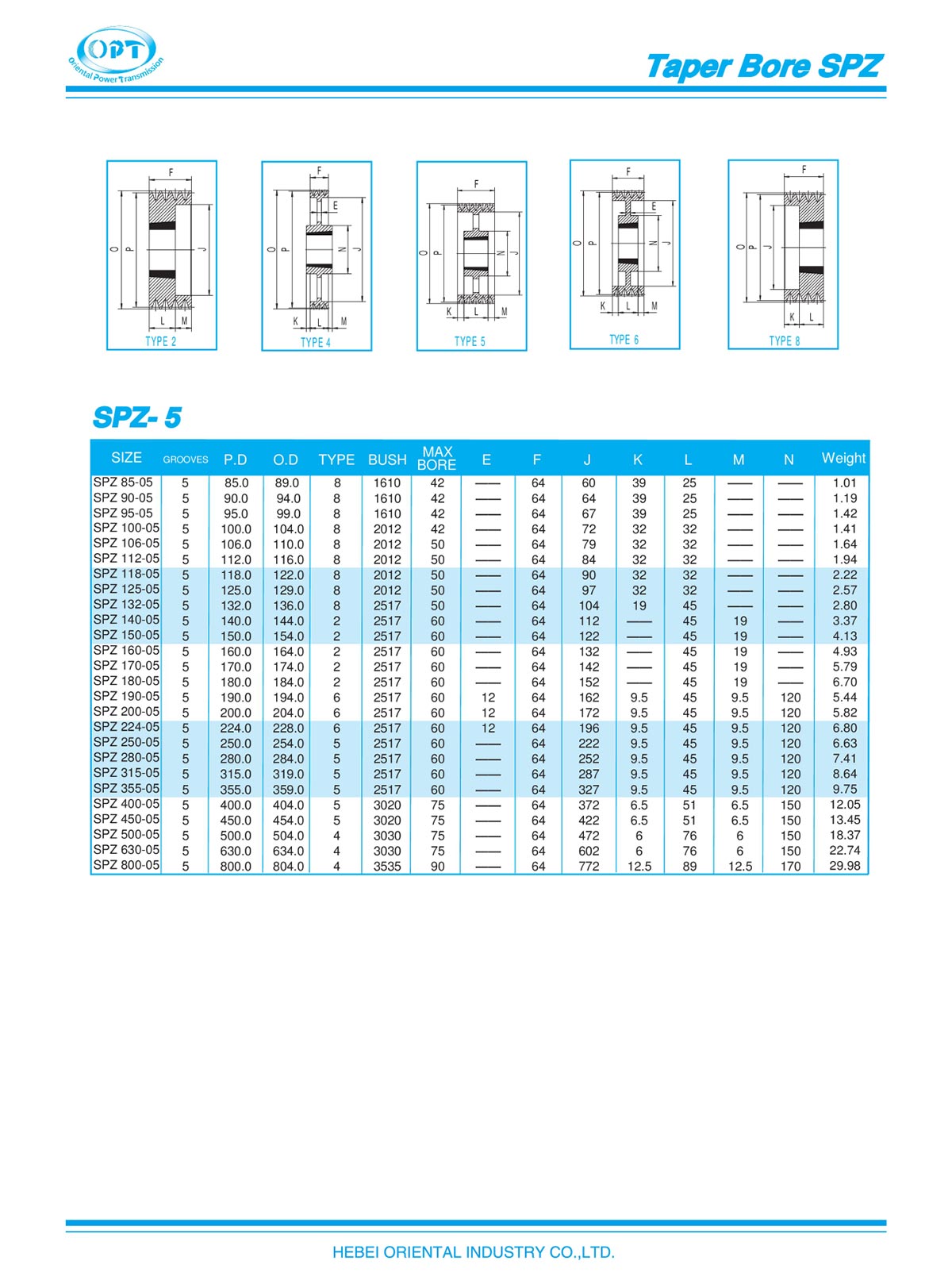
    SPZ taper bore V-pulleys are compact and suitable for light-duty applications requiring efficient power transmission. Designed for easy installation with taper bushes, they ensure secure mounting and stable operation. These pulleys are ideal for small machinery and systems with limited space requirements.
    SPZ-1  SPZ-2  SPZ-3  SPZ-4  SPZ-5  SPZ-6  SPZ-8


    SPZ V belt pulley
    1. Material: Cast iron GG25, Ductile iron
    2. Process: Machining – phosphating
    3. Standard: European and American Standard
    V pulley, v belt pulley, v groove pulley, v groove belt pulley, taper lock pulley, taper lock v belt pulley, taper lock bushing pulley, taper lock pulleys / taper bore pulley, large v belt pulley, double v belt pulley, cast iron v belt pulley belt pulley, variable speed v belt pulleys, v belt pulley split pulley, cast iron v belt pulley
    V belt pulley specifications:
    1) European standard:
    A) V-belt pulleys for taper bushings: SPZ, SPA, SPB, SPC; Up to 10 grooves
    B) Adjustable speed V-belt pulleys and variable speed pulleys
    C) Flat belt pulleys and conveyor belt pulleys
    2) American standard:
    A) Sheaves for taper bushings: 3V, 5V, 8V
    B) Sheaves for QD bushings: 3V, 5V, 8V
    C) Sheaves for split taper bushings: 3V, 5V, 8V
    D) Sheaves for 3L, 4L or A, and 5L or B belts: AK, AKH, 2AK, 2AKH, BK, BKH, 2BK, 2BKH, 3BK
    E) Adjustable sheaves: Poly V-pulley, multi-pitch H, L, J, K and M
    3) Bore: Pilot bore, finished bore, taper bore, bore for QD bushing
    4) Surface finish: Paint, phosphating, zinc plated
    5) Material: Cast iron, ductile iron, nylon, aluminum
    6) Made according to drawings and/or samples, OEM inquiries welcomed


    ew (1)

    ew (2)

    ew (3)

    ew (4)

    ew (5)

    ew (6)

    ew (7)


What Are the Three Types of Belt Pulleys?        

In power transmission systems, belt pulleys are essential components used to transfer motion and torque between rotating shafts. Although there are many specialized designs, three common types of belt pulleys widely used in industrial applications are flat belt pulleys, V-belt pulleys, and timing belt pulleys. Each type is designed to match a specific belt profile and performance requirement.

Flat belt pulleys are the simplest form, featuring a smooth, slightly crowned surface that helps keep the flat belt centered during operation. These pulleys are typically used in light-duty or high-speed applications where efficiency and low noise are important. They are common in older machinery, conveyors, and agricultural equipment. Because flat belts rely on friction, proper alignment and tension are critical for performance.

V-belt pulleys, also known as V groove pulleys, are the most widely used type in modern machinery. They have trapezoidal grooves that match the profile of V-belts. This design increases friction and allows for higher torque transmission compared to flat belt systems. V-belt pulleys are commonly used in motors, pumps, fans, and compressors. They are available in multiple groove configurations to handle different power loads and are often paired with components like taper lock bushings or QD bushings for secure shaft mounting.

Timing belt pulleys (or synchronous pulleys) are designed with teeth that mesh precisely with a toothed timing belt. Unlike friction-based systems, timing belt pulleys provide positive drive with no slippage, ensuring accurate speed ratios and synchronization. They are widely used in applications requiring precise motion control, such as CNC machines, robotics, and automotive engines.


What Are Belt Pulleys Used For?     

Belt pulleys are fundamental components in mechanical power transmission systems, used to transfer rotational motion and torque from one shaft to another through a belt. Their primary function is to enable efficient energy transfer between a driving source, such as an electric motor, and a driven component, such as a pump, fan, compressor, or conveyor system.

One of the main uses of belt pulleys is speed control. By varying the diameter of the driving and driven pulleys, engineers can increase or decrease the rotational speed of machinery. For example, a larger driven pulley will reduce speed but increase torque, while a smaller one will do the opposite. This flexibility makes belt pulley systems highly adaptable across different industrial applications.

Another important application is power distribution. In complex machinery, a single motor can drive multiple components using a system of belt pulleys and belts. This reduces the need for multiple motors and simplifies the overall design. Belt pulleys are also widely used to absorb shock and vibration, as belts provide a cushioning effect compared to direct gear drives, resulting in smoother and quieter operation.

In addition, belt pulleys are commonly used in industries such as manufacturing, agriculture, mining, and HVAC systems. They are found in equipment like conveyor belts, grain processing machines, industrial fans, and automotive engines. Modern belt pulleys are often designed with taper bore configurations, allowing easy installation using taper lock bushings, which improve alignment and reduce maintenance time.

Belt Pulleys FAQ

  • What are Belt Pulleys and how do they function in machinery?

    Belt Pulleys are mechanical components that transfer power between shafts using belts. They guide and support the belt while maintaining proper tension. This ensures efficient energy transmission and smooth operation in various industrial systems, including conveyors and manufacturing equipment.

  • How do Belt Pulleys affect power transmission efficiency?

    Belt Pulleys improve efficiency by ensuring proper belt alignment and reducing slippage. High-quality pulleys with accurate groove design minimize friction and vibration. This leads to better performance, lower energy loss, and extended lifespan for both the pulley and the belt.

  • What types of belts are compatible with Belt Pulleys?

    Belt Pulleys are compatible with several belt types, including V-belts, timing belts, and flat belts. The pulley design determines compatibility. Choosing the correct combination ensures optimal performance, reduces wear, and maintains consistent power transmission in industrial applications.

  • What materials are used to manufacture Belt Pulleys?

    Belt Pulleys are commonly made from cast iron, steel, or aluminum. These materials provide durability, strength, and resistance to wear. The choice of material depends on the application requirements, including load capacity, environmental conditions, and operating speed.

  • Why are Belt Pulleys important in industrial systems?

    Belt Pulleys are essential because they enable efficient and reliable power transmission. They help maintain proper belt tension, reduce mechanical stress, and improve system performance. Their versatility makes them suitable for a wide range of industrial and commercial applications.

Maximize Transmission Efficiency Using Taper Lock 1615 Systems
Maximizing Transmission Efficiency with the Taper Lock 1615 In the demanding world of power transmission, precision and stability are non-negotiable. The taper lock 1615 serves as a critical component in ensuring a secure, vibration-free connection between shafts and hubs. Whether utilized in heavy-duty gearboxes or general manufacturing equipment, this locking mechanism eliminates the need for expensive keyed shafts, reducing installation time and wear. Understanding the nuances of this component is essential for engineers aiming to optimize machinery uptime and operational safety in the gear and transmission industry.
Jul. 01, 2026
Optimize Industrial Power Transmission with Taper Lock 1008
Optimizing Mechanical Power Transmission with Taper Lock 1008 In the world of industrial machinery, achieving a secure and precise connection between a shaft and a hub is critical for operational efficiency. The taper lock 1008 serves as a high-performance fastening solution designed to eliminate slippage and reduce installation time. By utilizing a tapered sleeve mechanism, these components ensure a powerful 360-degree grip on the shaft, making them indispensable in gear manufacturing and general equipment production. Whether you are upgrading a conveyor system or building a new gearbox, understanding the technical nuances of the 1008 series is key to maximizing equipment lifespan.
Jun. 29, 2026
Optimize Power Transmission Using High Precision Taperlock Bushes
Optimizing Power Transmission with High-Precision Taperlock Bushes In the demanding world of general equipment manufacturing, the efficiency of power transmission depends heavily on the stability of the connection between the shaft and the hub. The use of taperlock bushes has revolutionized how engineers approach pulley and sprocket mounting. By utilizing a tapered design, these components ensure a secure, interference fit that minimizes slippage and reduces mechanical wear. Whether you are dealing with heavy-duty industrial machinery or precision timing systems, choosing the right fastening solution is critical for long-term operational reliability and reducing unplanned downtime in the manufacturing line.
Jun. 27, 2026

If you are interested in our products, you can choose to leave your information here, and we will be in touch with you shortly.